
For many small business owners and growing enterprises in the USA, the phrase “doing the books” conjures up a nightmare of lost receipts, mismatched numbers, and late-night anxiety attacks before tax deadlines. If you’re struggling to understand your profitability, dread tax season, or can’t pull an accurate financial report on demand, you aren’t alone.
The truth is, messy books aren’t just an inconvenience; they are a direct threat to your business’s survival. The U.S. bank reported that 82% of small businesses fail due to cash flow problems, a crisis that almost always begins with inaccurate or absent financial data.
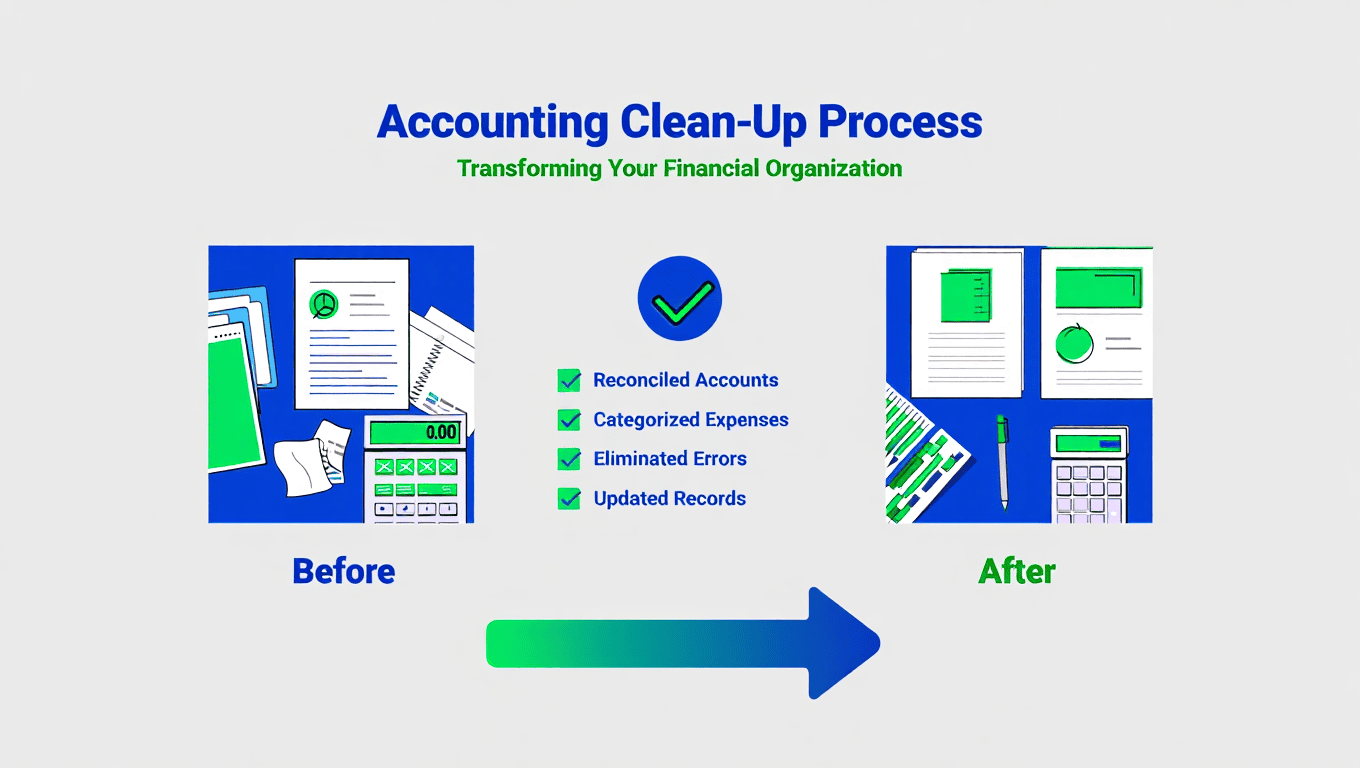
This is why an Accounting Clean-Up is the most critical investment you can make in your company’s future. It’s not just about fixing past errors; it’s about laying the foundation for strategic growth.
Here, we pull back the curtain on our expert-driven, systematic process. We’ll show you exactly how our Bookkeeping Clean Up Services transform financial chaos into crystal-clear confidence, ensuring you get the financial clarity you deserve.
Accounting Clean-Up Process Made Simple
Before diving into the solution, it’s essential to identify the problem. You need an accounting clean-up, also known as catch up bookkeeping, if you recognize any of these common pain points:
- The Tax Season Nightmare: You spend weeks scrambling to find receipts, your CPA is frustrated, and you end up filing an extension or incurring an IRS penalty because of missing documentation or inaccurate totals.
- The Cash Flow Mystery: Sales are up, but the bank account is low. You’re confused about why you’re profitable on paper but constantly struggling with cash on hand. Poor cash flow management is a primary symptom of bad books.
- The Data Disconnect: Your bank and credit card statements don’t match your general ledger. This lack of financial data accuracy means your financial reports are useless for making informed decisions.
- The Time Drain: You or an employee spends 80+ hours a year on tax prep (Source: SCORE study), time that could be spent generating revenue.
- The Software Mess: Your QuickBooks Online or Xero file is riddled with un-categorized transactions, personal expenses mixed with business expenses, and un-reconciled accounts stretching back months (or years!).
As data expert Michael Stonebraker wisely said, “Without clean data, or clean enough data, your data science is worthless.” In business, your financial data is your science. If it’s flawed, your decisions will be flawed.
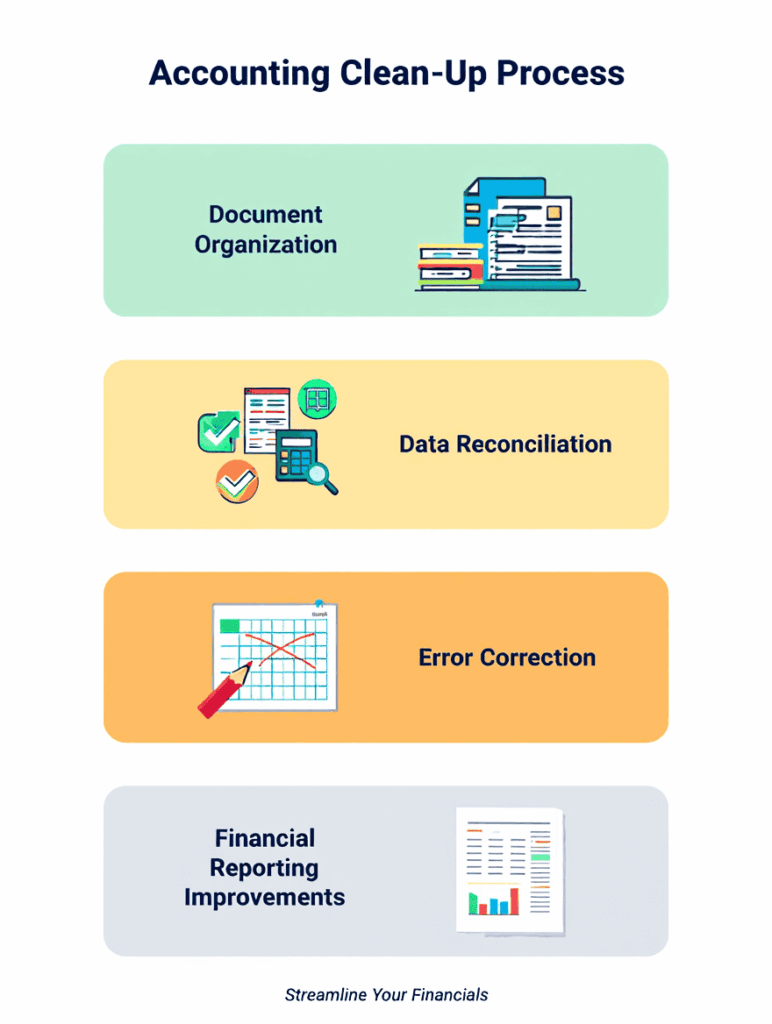
Next Level 7-Steps Accounting Clean-Up Process: The Path to Financial Health
Our comprehensive accounting clean-up process is designed to systematically dismantle the financial mess and build a robust, sustainable system. This approach is rooted in the highest standards of financial Expertise and Authoritativeness, ensuring your books are not just fixed, but perfected.
Phase I: Discovery & Documentation
Step 1: The Diagnostic Financial Assessment (Audit Scope Definition)
The first step in any successful remediation is understanding the full scope of the mess.
- What We Do: We meet with you to understand the history, current software (e.g., QuickBooks Online), and primary goals. We then conduct an initial review of your last filed tax return and current chart of accounts to determine how far back the clean-up needs to go. Common clean-up periods range from 3 months to 3 years.
- Key Deliverable: A formal Clean-Up Engagement Letter detailing the scope (start date to present), accounts included, and a fixed price for the service.
Step 2: Securing and Reconciling Core Data
This is where the heavy lifting begins, ensuring every dollar in your accounting software matches the reality of your bank and credit card statements.
- What We Do: We secure all historical bank and credit card statements. We then perform a full bank reconciliation for every month in the clean-up scope. This identifies missing transactions, duplicate entries, and any unauthorized or erroneous charges.
- Actionable Insight: We look for the most common errors, such as misclassified expenses and the fatal mistake of mixing personal and business finances
Phase II: Repair & Restructure
Step 3: Correcting Misclassifications and Categorization
A clean book file relies on transactions being coded to the correct accounts. Inaccurate categorization distorts your profit and loss statement and, critically, can lead to overpaying or underpaying taxes.
Common Error | How We Fix It | Impact on Your Business |
Personal transactions in business accounts | Reclassify as Owner’s Draw (or contribution) to clean the P&L. | Separates business performance from personal spending. |
Expenses coded to the wrong category (e.g., Marketing coded to Utilities) | Chart of Accounts Review and mass recategorization. | Ensures accurate P&L and correct tax deductions. |
Misclassification of contractors vs. employees (1099 vs. W-2) | Correct past payroll entries and ensure future compliance. | Mitigates the risk of IRS penalties and state labor audits. |
Step 4: Cleaning Up the Balance Sheet (A/R, A/P, and Equity)
A clean P&L is only half the battle; the Balance Sheet must also reflect reality. Often, years of neglect leave behind old, uncollectible invoices (Accounts Receivable – A/R) and stale, unpaid bills (Accounts Payable – A/P).
- What We Do: We analyze aging reports. We write off legitimately old and uncollectible A/R and clear any outstanding A/P that has already been paid (but was never marked as such). We also review the Equity Account to ensure all owner investments and draws are properly documented.
Step 5: Month-End Close and Report Generation
With all transactions cleaned, categorized, and reconciled, we perform a final month-end close for each period.
- Key Deliverable: We generate and review the three core financial statements: the Balance Sheet, the Profit & Loss (P&L) Statement, and the Statement of Cash Flows. These reports are now reliable, giving you an accurate picture of your financial health.
Phase III: Sustain & Strategize
Step 6: Training and System Implementation
A clean-up is worthless if the mess returns next month. We install protective measures and train your team (or you) on best practices.
- Actionable Advice: We help set up bank feeds, integrate receipt-tracking apps, and implement a streamlined workflow for expense approval and daily bookkeeping to ensure continuous financial data accuracy. We emphasize the importance of a monthly financial close.
Step 7: The Strategic Roadmap (The Next Level CFO Connection)
The most valuable step. The final, accurate financial reports allow us to pivot from remediation to strategy. This is the crucial link to our Outsourced CFO Services.
- Our Role: We analyze your newly cleaned data to identify immediate opportunities and threats:
- What is your true gross margin?
- Which expenses are bleeding cash?
- What is your runway based on accurate cash flow management?
This step transforms a simple Bookkeeping Clean Up Service into a strategic springboard for growth.
Beyond the Clean-Up: The Strategic Power of Outsourced CFO Services
An accounting clean-up is the necessary precursor to high-level strategic guidance. Once your financial data is trustworthy, you can leverage it with a Virtual CFO or Outsourced CFO (also known as part-time fractional CFO) to drive real business growth.
Why Transition to an Outsourced CFO After a Clean-Up?
Hiring a full-time, in-house CFO is prohibitively expensive for most small to mid-sized businesses, with annual salaries often exceeding $200,000. Outsourced CFO Services offer a fraction of the cost for high-impact expertise.
| Service Level | Focus | Example Benefit (Post-Clean-Up) |
| Bookkeeper/Cleanup | Historical transaction recording and data accuracy. | Ensures all 2024 expenses are correctly categorized and reconciled. |
| Outsourced CFO/Strategic | Forward-looking strategy, forecasting, and profitability analysis. | Uses the clean 2024 data to build an accurate 2025 budget and cash flow forecast, advising on optimal pricing strategy. |
- Strategic Planning: The CFO uses the clean data to help you determine capital structure, assess cost-cutting opportunities without bias, and align financial decisions with long-term goals.
- Enhanced Valuation: If you are planning an exit or seeking capital, a clean, auditable set of books dramatically increases your business’s value and credibility with investors.
- Scalability: Companies that partner with professional financial services are reported to grow up to 30% faster. The focus shifts from “counting the beans” to using the numbers to make every bean count.
Book Your Accounting Clean-Up Consultation Today!
Don't wait until the next tax deadline to find out. Click the link below to schedule your free, no-obligation Diagnostic Financial Assessment with one of our certified accounting experts.
FAQs
What is an accounting clean-up and why is it important?
What problems can an accounting clean-up fix?
An accounting clean-up resolves issues like unreconciled accounts, miscategorized expenses, missing transactions, and outdated records—restoring accuracy and financial confidence.
How long does a typical Bookkeeping Clean Up Service take?
It depends on the volume and depth of the mess, but here’s a typical range:
- Light Clean-Up (3-6 months behind): 2–4 weeks
- Moderate Clean-Up (7–12 months behind): 4–8 weeks
- Extensive Clean-Up (Multiple years): 8–12+ weeks
The faster you can provide the necessary documentation (bank statements, tax returns), the quicker the resolution.
Should I fix my books myself using AI/Chat GPT tools?
While AI tools can automate routine data entry, they are not a substitute for professional human judgment, especially during a complex accounting-bookkeeping clean-up. AI can only categorize what it sees.
It cannot differentiate between complex tax law nuances, reclassify ownership equity, or structure a clean chart of accounts that aligns with advanced tax planning. Think of AI as a power washer; a CPA is the architect who redesigns the foundation.
What documents do you need from me to get started?
To start the diagnostic financial assessment, we primarily need:
- Access to your current accounting software (e.g., QuickBooks Online access).
- All bank and credit card statements for the scope period.
- Your most recent Federal Tax Return.
- Payroll reports (if applicable).
Is an Accounting Clean-Up tax-deductible?
Yes – in most cases, accounting clean-up services are tax-deductible because they fall under ordinary and necessary business expenses.
Businesses typically deduct:
- Bookkeeping cleanup
- Reconciliation work
- Correcting prior errors
- Organizing financial records
- Preparing accurate statements
However, the exact deductibility can depend on your location and tax laws, so it’s always smart to confirm with a CPA or tax professional for your specific situation.