

For finance leaders, the Cost of Goods Sold (COGS formula) defines the heartbeat of profitability. It links what happens in operations to what appears in profit reports by clearly showing how beginning inventory + purchases − ending inventory translate into real costs. Each figure within the COGS calculation reveals how resources are used and where efficiencies are gained. When the COGS formula is applied accurately, it offers a clear picture of performance.
Leaders can see where value is created and where waste quietly steals margin. But when the COGS formula is misapplied or based on poor data, it clouds visibility and weakens control, leading to pricing errors and misaligned priorities. Accurate use of the Cost of Goods Sold formula turns raw data into actionable financial insight.
It supports smarter forecasting and sharper strategy. For modern finance leaders, understanding COGS is understanding business itself. It is precision turned into profit, and insight turned into action. This guide shows what to include in CoGS, how to calculate cogs, and how teams can use it to improve pricing and forecasting.
What is COGS?
COGS captures the direct costs of producing or acquiring the goods a business sells during a period. It answers a fundamental question: “What did we pay in direct, traceable costs for the inventory that was actually sold this period?” The specific components depend on the business model.
They typically include direct materials consumed in production. They include direct labour required to manufacture goods. Include freight-in and handling costs to bring the inventory to usable condition.
Include manufacturing overhead directly tied to production, such as machine depreciation, factory utilities, and production supervision. For retail and distribution businesses, they include purchase costs for resale inventory. Keep the basics right with raw materials, direct labour, and purchase costs for resale goods. That keeps the cost of goods sold formula clean and useful.
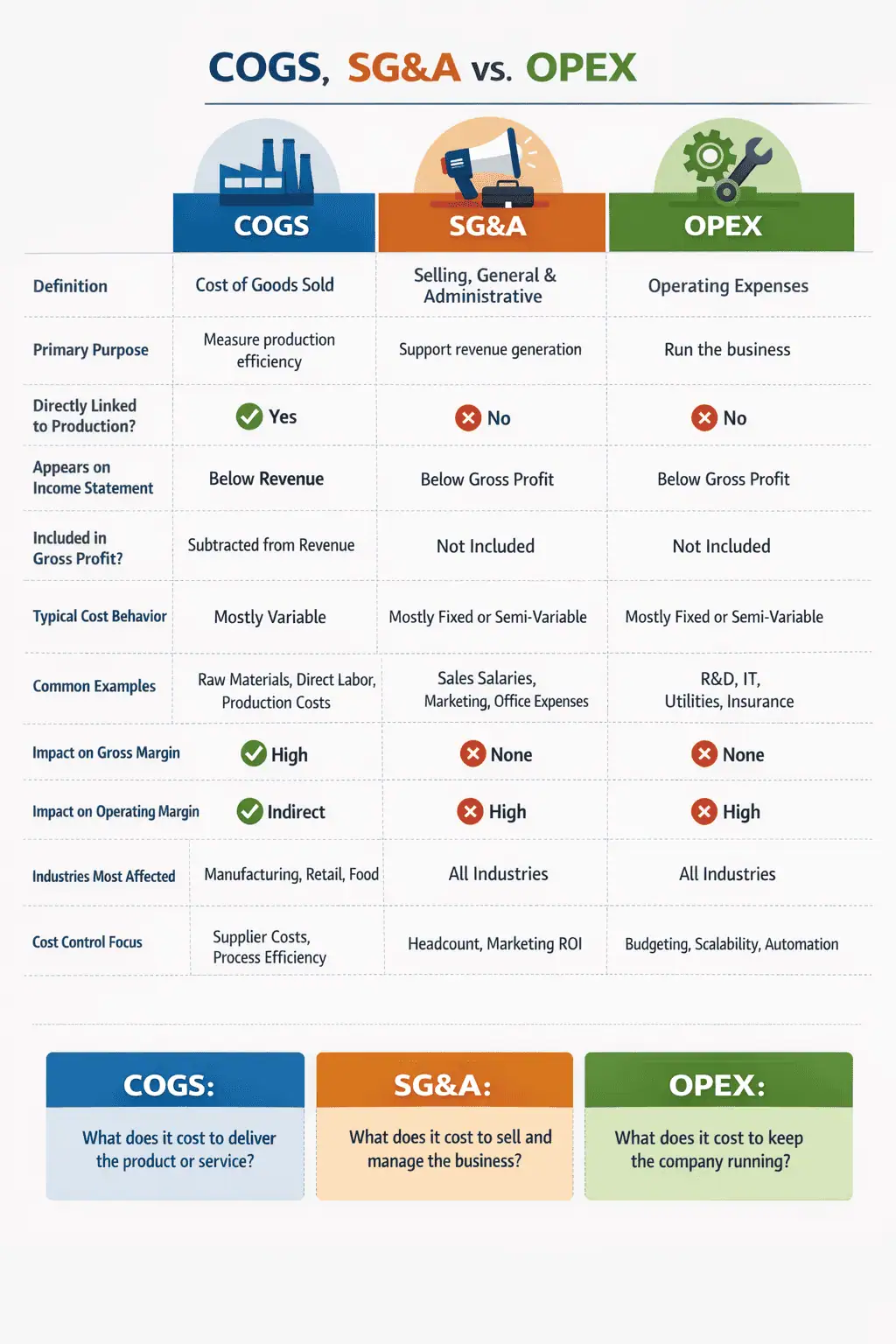
Costs that support the business but are not directly linked to individual units belong elsewhere. Headquarters rent, sales salaries, and corporate IT belong in operating expenses, not COGS. Drawing this distinction consistently is critical to credible gross margin reporting.
How to calculate the cost of goods sold?
The basic COGS formula used in financial reporting is straightforward. Beginning inventory plus purchases or production costs minus ending inventory equals COGS.
Each component carries significant weight. Beginning inventory represents the value of unsold goods from the prior period. Purchases or production costs include all direct costs incurred to acquire or manufacture products during the current period.
Ending inventory captures the value of goods still on hand at period end, measured using the company’s chosen inventory valuation method. CoGS is calculated by adding beginning inventory to purchases and subtracting ending inventory.
Understanding Cost of Goods Sold COGS Formula
COGS = Beginning Inventory + Purchases − Ending Inventory
What each part means:
- Beginning Inventory: Value of inventory at the start of the period
- Purchases: Cost of inventory bought during the period (including direct materials and freight-in)
- Ending Inventory: Value of inventory remaining at the end of the period
Simple example:
- Beginning Inventory: $25,000
- Purchases: $40,000
- Ending Inventory: $15,000
COGS = 25,000 + 40,000 − 15,000 = $50,000
- Why COGS matters:
- Directly impacts gross profit
- Helps measure pricing accuracy and margins
- Essential for tax reporting and financial analysis
Gross Profit Formula:
Gross Profit = Revenue − COGS
That’s how to calculate the cost of goods sold. Beginning inventory is the last period’s closeout. Purchases cover everything bought to resell or build during the month or year. Ending inventory? Count it physically or trust your system; sloppy counts affect accuracy here.
What is Include and Exclude in COGS?
| Include in COGS | Exclude from COGS |
| Raw materials | Marketing and advertising |
| Direct labor (production workers) | Sales commissions |
| Manufacturing supplies | Office rent and admin salaries |
| Freight-in and inbound shipping | General office utilities |
| Factory or production utilities | Internet and phone expenses |
| Packaging directly tied to products | Accounting and legal fees |
| Equipment depreciation (production use) | Research and development |
| Inventory purchase costs | Outbound shipping to customers |
| Import duties and customs fees | Payment processing fees |
| Contractors delivering billable work | Customer support costs |
| Software used exclusively for production or client work | General software subscriptions |
Inventory Valuation Methods and Their Impact
Finance teams must select and consistently apply an inventory costing method. This choice directly affects COGS and gross profit reported.
FIFO (First-In, First-Out) assumes the earliest units purchased or produced are sold first. In an inflationary environment, FIFO typically results in lower COGS and higher gross profit. However, it produces a higher inventory value on the balance sheet.
LIFO (Last-In, First-Out) assumes the most recent units are sold first. Under rising costs, LIFO generates higher COGS and lower taxable income. The trade-off is a lower inventory value carried on the balance sheet. LIFO is allowed under U.S. GAAP but prohibited under IFRS.
Weighted average cost smooths price fluctuations by averaging costs over the period. COGS and inventory values using this method fall between FIFO and LIFO results. For a finance leader, the method choice is not merely a compliance decision. It influences tax planning, reported margins, and how stakeholders interpret business performance.
COGS in a Manufacturing Business
Consider a manufacturing company that produces custom metal components. In a typical month, the finance team gathers several key inputs. Collect direct materials issued to production. Track direct labour hours applied to specific jobs, multiplied by standard or actual labour rates. They allocate manufacturing overhead such as depreciation, plant utilities, and indirect labour.
These costs flow through work-in-process and finished goods inventory accounts. They remain there until the goods are sold and recognized in COGS. The operational challenge is ensuring production reporting, bills of materials, and labour tracking accurately reflect reality. Without accuracy, unit costs become unreliable. Margins by product line become distorted.
COGS in a Retail or Distribution Environment
For retailers and distributors, the mechanics differ, but the principle remains the same. The key cost driver is the purchase price of inventory. This must be adjusted for trade discounts and rebates. It must account for freight-in and duties. It must reflect shrinkage, damage, and obsolescence.
Here, the finance function relies heavily on point-of-sale data, purchase records, and physical stock counts. Weak controls create problems. Infrequent physical counts introduce errors. Inconsistent write-downs mask issues. These problems can cause material misstatements in COGS and gross profit, particularly in high-volume, low-margin segments
COGS, SG&A, and OPEX
Why COGS Matters to Finance Leadership
Strong finance functions use COGS as a strategic instrument, not merely a compliance requirement. Several applications stand out.
Gross margin analysis depends directly on accurate COGS. Detailed analysis by product, customer segment, or channel reveals where the business truly earns money. It exposes where the business subsidizes unprofitable activity.
Pricing and discount strategy cannot succeed without accurate COGS. Finance teams should partner with sales and product teams to establish minimum price floors. These floors must be based on fully loaded direct costs.
Budgeting and forecasting rely on solid COGS estimates. COGS forecasts translate volume assumptions into expected gross profit. Reliable models consider input price trends, labour productivity, capacity utilization, and expected changes in product mix.
Working capital management is closely tied to inventory valuation. High inventory days and frequent write downs signal that capital is trapped in slow-moving or obsolete stock. This warning deserves immediate attention.
Tax and compliance considerations are significant. The choice of inventory method, capitalization policies, and overhead allocation rules all carry tax implications. In jurisdictions where LIFO is permitted, higher COGS can reduce taxable income during inflationary periods.
Regulators demand consistent treatment and clear disclosure. Finance leaders should collaborate closely with tax advisors. This alignment ensures COGS policies comply with statutory expectations.
Common Pitfalls in COGS Calculation
Even sophisticated organizations make errors that materially affect COGS. Several recurring issues deserve attention. Incorrect capitalization policies create distortions. Over-capitalizing overhead inflates inventory and depresses COGS in the short term. Under-capitalizing has the opposite effect and understates margins.
Infrequent or poor-quality inventory counts introduce significant risk. If physical counts are inaccurate or rare, variances accumulate over time. COGS becomes a plug rather than a reliable measure.
Applying rules differently across locations disrupts consolidated reporting. Varying inventory methods or costing assumptions between plants or regions reduces the ability to compare results. They make consolidated reporting less reliable.
Weak integration between operations and finance systems creates opacity. If production, purchasing, and sales data are fragmented, cost flows become unclear. Reconciliation efforts consume excessive time and resources
Strengthening COGS Practices: A Finance Agenda
Finance teams seeking more reliable and actionable COGS numbers can focus on practical initiatives. Several areas offer high-impact opportunities.
1. Establish Clear Financial Definitions and Cost Policies
First, build alignment across departments on financial definitions and cost classification policies. Define direct costs in precise terms and specify which overheads qualify for capitalization. Confirm that accounting, operations, and supply chain teams have a shared understanding of these distinctions.
2. Strengthen Alignment Between Operations and Accounting
Align operations and accounting more closely. Make sure BOMs, routings, labour standards, and overhead rates represent actual production. Integrate ERP and inventory systems if possible. These actions reduce rework, elevate accuracy, tighten control, and improve cost management across the business.
3. Enhance Inventory Visibility and Control
Improve control over inventory company-wide. Schedule routine cycle counts and consistent write-off practices. Investigate the variance causes carefully. Require finance to monitor key measures like inventory days, turnover rates, and category-level write-offs to maintain accuracy and inventory discipline.
4. Costing and Margin Reporting Capabilities
Advance costing systems and margin tracking. Set up profitability dashboards at product and customer levels. Compare gross margins across locations, units, and sales channels. Conduct regular variance analysis. These steps expose inefficiencies sooner and highlight cost changes.
5. Integrate COGS Analysis into Strategic Decision-Making
Integrate COGS analysis into routine planning and decisions. Tie monthly margin reviews to capital allocation. Align cost improvements with strategic priorities. Present gross margin trends clearly to the board and leadership team for informed oversight and timely action.
Get the Ultimate CoGS Guide with NextLevelCFO
Overwhelmed by financial complexity, holding back your business? Next Level CFO provides the fractional leadership in finance, accounting, and HR that transforms challenges into breakthroughs. Like a shift from $250K to $40M revenue growth in four years for one staffing client, or $5M across 20+ states in 18 months for another.
From month-end closes to strategic forecasting, we deliver clarity and control. Take the first step toward unlocked potential. Book your complimentary strategy call, and start building your roadmap today.
Book a Consultation Today!
Don't wait until the next tax deadline to find out. Click the link below to schedule your free, no-obligation Diagnostic Financial Assessment with one of our certified accounting experts.
FAQs
Why do we need to lock down our definitions for direct costs and overheads?
If Accounting thinks a cost is an expense but Operations thinks it’s an asset, your financial data becomes unreliable fast. You need agreement on what is capitalized and what is expensed. That alignment keeps reports accurate and grounded. Without it, you get inconsistent figures that make decisions far more difficult.
What happens when Operations and Accounting systems aren't talking to each other?
If your bills of materials and labor standards don’t match what’s physically happening on the shop floor, your margins are effectively imaginary. By syncing these standards and integrating your ERP, you stop relying on manual fixes at the end of the month. It cuts down on rework and gives you a cost structure you can actually trust.
How do we stop losing money through inventory discrepancies?
It comes down to routine and visibility. You can’t just count stock once a year; you need regular cycle counts and a strict process for write-offs so nothing gets swept under the rug. On top of that, Finance needs to be watching the clock tracking how fast stock turns over and spotting variance trends early. If you aren’t digging into the root causes of those variances, you’re leaking cash without knowing why.
Why isn’t high-level margin reporting enough anymore?
A blended margin can hide a lot of problems.You may show strong total profits yet still lose money in certain customers or markets. A detailed breakdown is essential. Product-level and channel-level views expose issues fast. With that insight, you can correct problems before they hurt quarterly performance.
How should COGS analysis actually influence our strategy?
Cost of Goods Sold shouldn’t just be a line item we look at after the fact. It needs to drive where we put our money next. When margins decline, leadership needs to discuss capital decisions or process fixes immediately. Showing these changes to the board is important. It connects them to the company’s goals. This makes cost management a strategic tool.