
In many businesses, finance titles get thrown around so often that they start to blur together. That’s especially true with comptroller vs controller. The words sound almost identical, and historically, one came from a spelling twist of the other.
But in practice, these are two very different jobs serving very different types of organizations. They work with numbers. Both oversee accounting. They sit in senior financial seats. Yet only one is truly set up to push profitability and give leadership a tight grip over profit control.
To see why, this blog helps to understand the real difference between controller services and comptroller, how each role operates day to day, and what they’re ultimately accountable for.
Comptroller vs Controller: Understanding Key Differences
Before comparing them, it’s worth acknowledging that Controllers and Comptrollers share quite a bit of common ground. Both roles:
- Lead the accounting function and supervise finance staff.
- Oversee the general ledger, chart of accounts, and core accounting processes.
- Oversee the accuracy of financial reporting and facilitate audit processes.
- Help enforce internal controls, policies, and financial standards.
You’ll often see similar qualifications as well: accounting degrees, CPA licenses, and sometimes MBAs or other advanced credentials. On paper, they can look very similar, and if you only saw their resumes, you might assume they do the same type of work.
The divergence shows up not in what they can do, but in what they’re hired to deliver. One role is tasked with improving financial performance. The other is tasked with protecting and properly spending funds.
Inside the Finance Controller's World
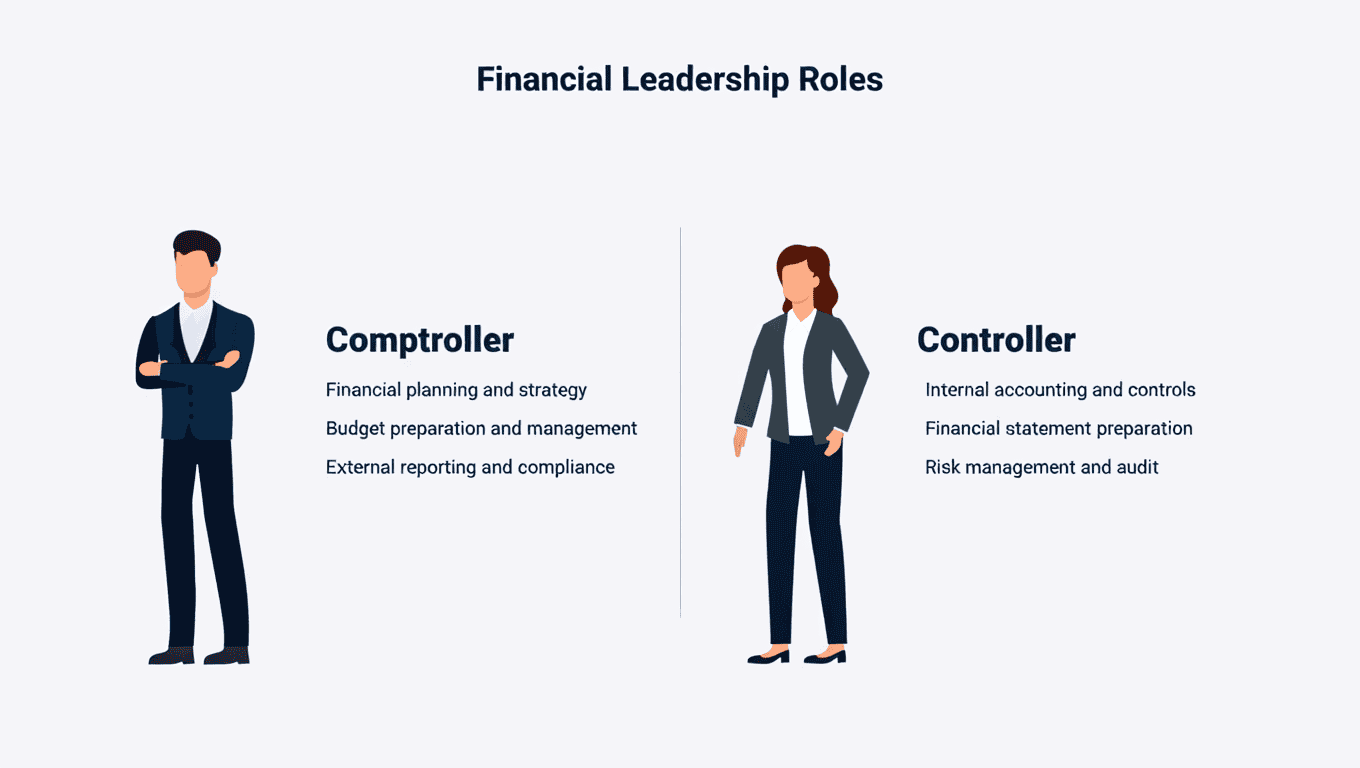
The Finance Controller’s role lives almost exclusively inside for‑profit companies: manufacturers, tech firms, service businesses, private equity-backed groups, and so on. Typically, the controller reports to the CFO and operates as the nerve center of the internal finance function.
A strong controller is less a head bookkeeper and more a strategic operator who keeps a constant eye on profitability. Common responsibilities include:
- Managing day‑to‑day accounting, payables, receivables, billing, revenue recognition, inventory, fixed assets, and tax-related filings.
- Building and monitoring budgets and forecasts, then analyzing variances between plan and actuals.
- Reviewing financial trends, cost metrics, and margin results to understand where profitability is rising or slipping.
- Building checks and safeguards that keep finances accurate and support better cash flow and spending control.
In short, the Finance Controller’s job is tied tightly to the bottom line. The controller takes the company’s financial data and turns it into usable insight: where are we overspending, where are we underpricing, which lines of business are actually carrying the profits, and which are dragging us down?
When leaders talk about tightening profit control, getting better visibility, eliminating waste, and making smarter decisions, the controller is usually at the center of that effort.
Controller Versus Comptroller: How Their Focus Shapes Outcomes
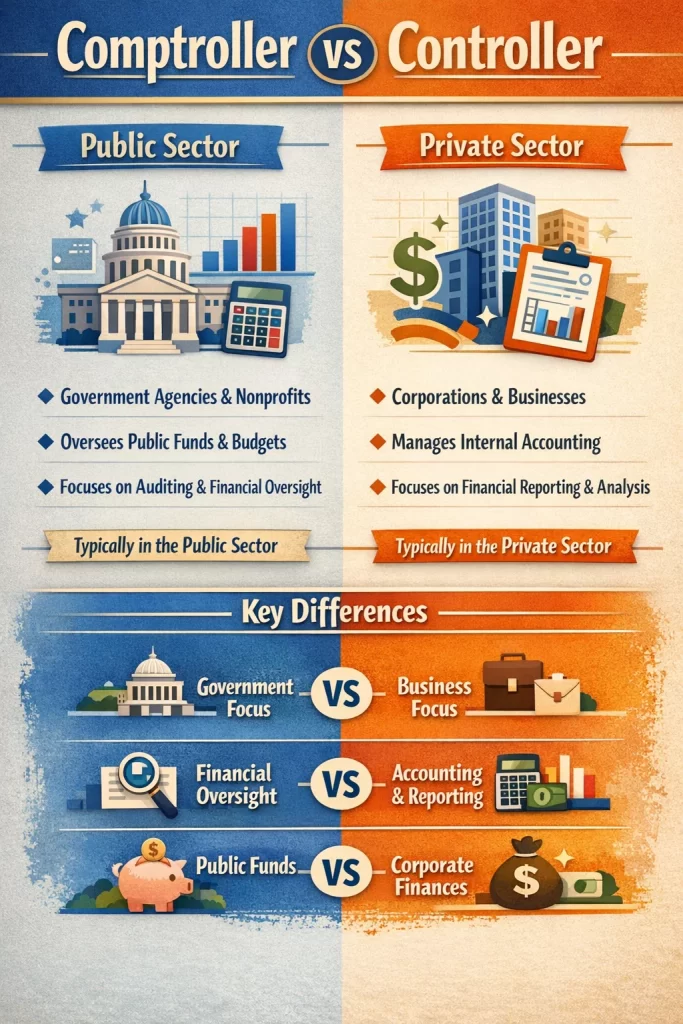
When you put Controller Versus Comptroller side by side, the contrasts come into focus:
Type of organization
- Controller: for‑profit companies focused on growth, margins, and shareholder value.
- Comptroller: government entities and nonprofits focused on service delivery and public or donor accountability.
Primary mandate
- Controller: improve and protect profitability and overall financial health.
- Comptroller: Keep spending within authorized budgets and ensure funds are used correctly.
Core lens on money
- Controller: “How do we increase returns, improve margins, and allocate resources more efficiently?”
- Comptroller: “Are we following the rules, staying within budget, and honouring donor or taxpayer expectations?”
Both roles are vital in their respective worlds, but their success metrics are fundamentally different. A controller’s work is judged largely through income statements, KPIs, and trend lines. A comptroller’s work is judged through budgets, compliance, and public trust.
Which Role Actually Drives Better Profit Control?
When the question is framed specifically around profit, who drives better control over profit and financial performance? The answer points clearly to the controller. A controller is embedded in a profit‑oriented environment and is expected to:
- Monitor and influence cost structures.
- Provide management with timely, actionable reporting on margins and performance.
- Help shape budgets and forecasts to support growth and profitability.
- Flag financial risks early and recommend corrective actions.
The Finance Controller’s toolkit is built for profit control: detailed variance analysis, cost breakdowns, revenue trends, cash flow projections, and scenario modelling. Their decisions and insights directly influence how much profit the business ultimately keeps.
By contrast, a Finance Comptroller’s toolkit is built around compliance, fund allocation, and budget discipline. The role is every bit as sophisticated, but it is not designed to push profitability, because profitability is not the mission in those environments.
Choosing the Right Role for Your Organization
If you’re running a for‑profit business and grappling with questions like:
- “Why are our margins shrinking?”
- “Where are we overspending?”
- “How can we improve profit without hurting operations?”
Then the skill set you need lives squarely in the controller camp. If, on the other hand, your organization is a municipality, a state agency, a charity, or a nonprofit hospital, and your main concerns are:
- “Are we using restricted funds correctly?”
- “Are we staying within legal and grant constraints?”
- “Can we withstand public and regulatory scrutiny?”
Then a comptroller is the more natural fit. When you frame comptroller vs controller in terms of mission, the distinction becomes obvious: both manage money, both enforce control, but only one is structurally built to drive profit control in a business setting.
For private-sector companies, the controller is the role that directly supports stronger profitability and tighter financial performance.
Consult with our financial specialists to strengthen your controls.
At Next Level CFO, our financial leaders are well-versed in the strategic insights that contribute to growth and increasing profit. From clarifying the nuanced roles of controllers and comptrollers, our expertise can push your organization’s growth in today’s dynamic business era. Contact us today to lead your company confidently with clarity and control.
Book A Free Strategy Call
Your personalized roadmap starts with one call.
Frequently Asked Questions
What's the real difference between a controller and a Comptroller?
A controller usually works in a for‑profit company, focused on profit, reporting, and internal controls. A Comptroller typically serves government or nonprofits, where the priority is budgets, fund tracking, and staying fully compliant with public or donor rules.
Which role is better for profit control in a business?
For profit‑driven companies, the controller is the key player. They dig into margins, costs, and cash flow, then give leadership practical guidance on pricing, spending, and strategy, so financial decisions actively support stronger and more stable profitability.
Does a smaller business really need a controller?
Yes, especially once revenue and expenses start getting complex. A controller brings structure to your numbers, cleans up reporting, and highlights where money is being made or wasted, helping owners avoid surprises and make decisions with a lot more confidence.
When would an organization choose a Comptroller instead of a controller?
A Comptroller makes more sense when you manage public money or restricted funds, like grants and donations. The job is to prove every dollar was used as promised, stay within approved budgets, and keep regulators, boards, and stakeholders comfortable.
How can an outsourced or fractional controller help with profit control?
An outsourced controller gives you senior finance support without a full‑time salary. They refine your processes, tighten controls, improve reporting, and point out specific actions to protect margins and cash, ideal for growing companies not yet ready for a permanent hire.